
Pet Ultrasound & Echocardiography Services at South Broward Animal Hospital in Fort Lauderdale, FL
Unlock invaluable insights into your beloved pet’s health and well-being through the advanced ultrasonography services at South Broward Animal Hospital.
Understanding Ultrasound & Echocardiography: Probing the Depths of Pet Health
For advanced imaging, we offer access to a traveling ultrasonographer who performs both abdominal ultrasounds and echocardiograms right here in our hospital. Ultrasound allows us to evaluate soft tissues—such as the liver, kidneys, spleen, bladder, and gastrointestinal tract—in real time. It helps us diagnose tumors, growths, organ changes, and other internal conditions that cannot be detected through a physical exam alone. Ultrasound can also guide needle aspirates or biopsies when needed, giving us clearer answers with minimal stress to your pet.
Echocardiograms (heart ultrasounds) provide a detailed look at the heart’s structure and function. These studies are sent directly to a board‑certified cardiologist, who reviews the images and provides a comprehensive report. This report includes a detailed treatment plan for any heart disease present, along with recommendations for anesthetic safety when procedures are necessary. Having these services available on‑site means your pet receives high‑quality, specialized imaging without the stress of traveling to another facility.
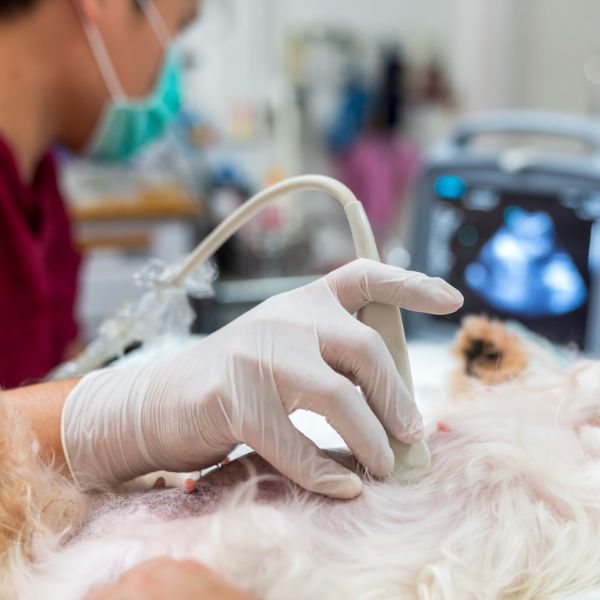
Unraveling Ultrasonography: How It Reveals Your Pet’s Health
An ultrasound works by broadcasting high-frequency sound waves that reflect off your pet’s internal structures. A small probe held against the skin collects the returning signals to create an image of the internal body, most commonly used to examine abdominal organs like the stomach, kidneys, liver, spleen, and gallbladder. An echocardiogram, or ultrasound of the heart, provides precise information about heart valves, blood flow, chamber size, and contractions. This tool is essential when assessing overall heart health and treating cardiovascular disease. Because an ultrasound doesn’t require radiation, it is also used to monitor pregnancies and fetal health in breeding pets.
When used in conjunction with other diagnostics tools like radiographs (X-rays), ultrasonography can detect a broad range of abnormalities including cardiovascular disease, skeletal fractures, some forms of cancer, soft tissue damage, foreign bodies, and organ disease. Completely painless and non-invasive, ultrasounds rank among the most precise diagnostic tools in the veterinary industry.
When Is Ultrasonography Necessary?
Ultrasonography may be recommended in various scenarios, including:
- Investigating gastrointestinal issues
- Evaluating urinary tract disorders
- Assessing cardiac function
- Monitoring pregnancy
- Detecting tumors or abnormal growths
Ultrasonography plays a crucial role in identifying abnormalities in organs like the liver, spleen, and pancreas, as well as in reproductive organs. It is also used to guide biopsies or aspirates, evaluate musculoskeletal injuries and abnormalities in soft tissues, and look for abnormalities or signs of disease in the thyroid gland, adrenal glands, and other endocrine organs.
During surgery, ultrasound guides vegetarians with precise imagery of internal structures. In wellness exams, it monitors the progression of chronic diseases or conditions over time, including assessing blood flow and circulation in specific organs or tissues and screening for congenital abnormalities or developmental issues.